


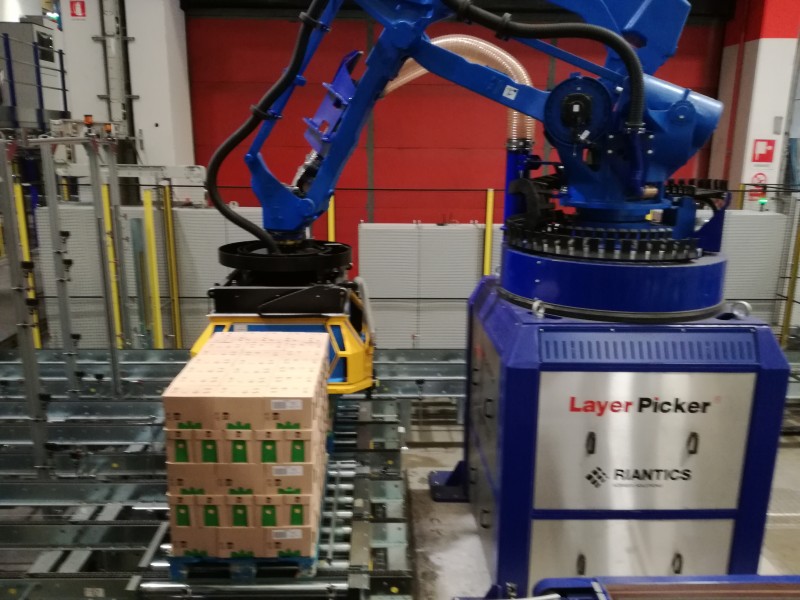
Collaboration between man and robot
The renovated logistics centre consists of a large covered warehouse with three main bodies: a traditional central warehouse and two automatic warehouses on the sides. In the central warehouse, order picking and dispatch activities take place. In this warehouse, the new automatic line for picking activities while in the two automated warehouses product entry and storage activities are carried out. The pallets unloaded from the vehicles are stored in the automatic warehouses and, on request, can be directed either to the 14 loading bays or to the supply lines of the new automatic picking line.
The pallets are placed on the two infeed lines to arrive at the first work station where the operator removes any type of impediment (film, cardboard flaps...) to the depalletising by the robot, activity that takes place immediately afterwards. In this phase the robot destratifies the pallet, one to three layers at a time depending on the weight and size of the articles, up to a maximum of three at a time to form the layers required by the different orders. In the event that the orders require less than one layer, the layer is divided into individual packages, which are then located in the automatic package warehouse, thanks to the real-time location assignment by the system. Simultaneously with the destratification and singularisation activities the system starts to extract the ready-made layers from the pallet magazine to form the final order pallet.
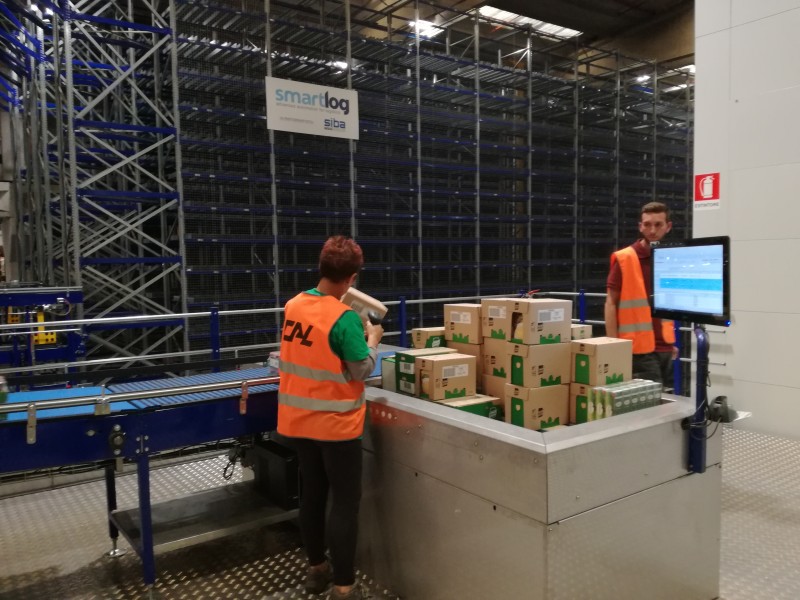
Also loose packages are picked up from the plant by two stacker cranes and taken directly to the operators for manual pallet assembly, giving priority to the heaviest packages that will form the first layer of the pallet. For pallet assembly, the operator is guided by the information shown on the display, essentially the picking quantities, paying attention to the scanning of each individual package picked. Once the order of loose packages has been completed, the operator tells the system that the pallet can be sent to the exit line, suitably covered with transparent film to prevent accidental drops. The pallet formed by the loose parcels remains stored in the warehouse area equipped with shelves until the customer order is completed, after which the order pallet, which can reach a maximum height of two metres, is advanced towards the’automatic labeller for identification by barcode and taken to the outbound area to be picked up by the transporter.
Finally, since there are packages in the warehouse that due to size or weight cannot be handled by the robot stations, there is also a vertical warehouse containing 325 locations. If the article requested by the customer is present in the silo, the system will search for the corresponding location and make it accessible to the operator, who will only have the task of picking up the quantity displayed on the screen, scanning the code and placing it on the pallet in composition.
Below are the figures for the robotic system built by Innocenti Depositi:
2 single-article pallet input lines
2 robot layers
Cycle time: 160 cycles/hour per robot
1 pallet warehouse (layer) served by 3 stacker cranes
Cycle time: 44 combined cycles/hour per stacker crane
Capacity 10 layers for total pallet places (layers): 2,880
1 parcel warehouse served by 2 stacker cranes
Cycle time: 250 packages/hour per stacker crane
Capacity 6,800 channels equivalent to approximately 40,800 packages
2 loose package preparation wells
Cycle time: 350 packages/hour per well
1 vertical drawer magazine
Capacity 325 drawers equivalent to 325 layers of product
2 output lines.